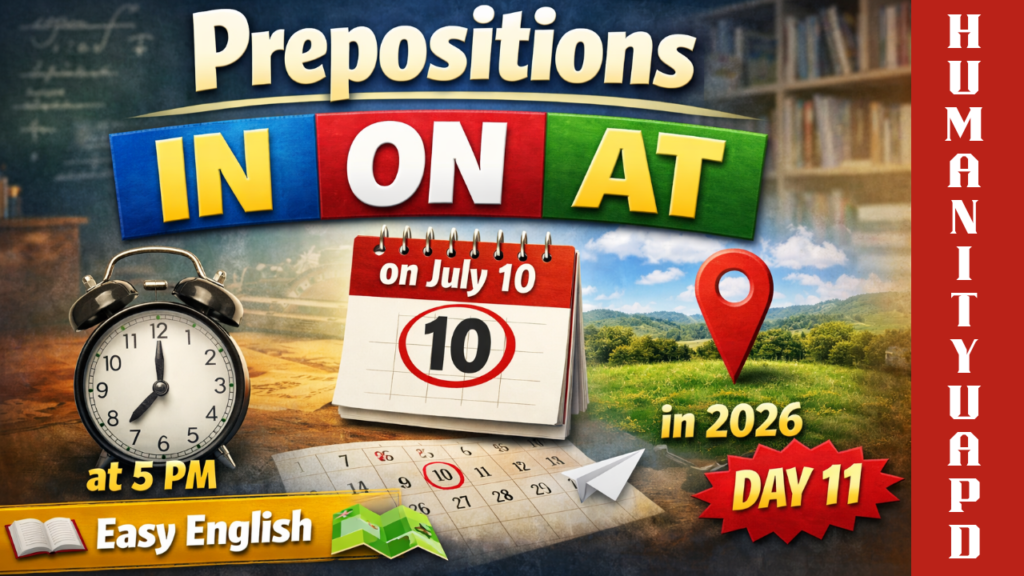
Prepositions In-On-At
Prepositions are essential components of English grammar that serve to establish relationships between different elements within a sentence. Specifically, they connect nouns, pronouns, or phrases to other words, clarifying how they interact within the context of a statement. By doing so, prepositions play a crucial role in conveying various types of relationships, primarily concerning time, place, and direction.
In the realm of language, prepositions function as a bridge that links different parts of a sentence. For example, in the phrase “The book is on the table,” the preposition “on” connects the noun “book” to the noun “table,” indicating a spatial relationship. Similarly, prepositions can also indicate time, as illustrated in the sentence “We will meet after lunch,” where “after” denotes a relationship concerning temporal sequencing. Additionally, prepositions can express direction, as shown in the sentence “She walked toward the park,” where “toward” indicates the direction of movement.
Furthermore, prepositions often require the use of objects. In many cases, a preposition is followed by a noun or pronoun to complete its meaning, forming what is known as a prepositional phrase. For instance, in the phrase “at the store,” “at” is the preposition, and “the store” serves as its object. This combination provides listeners and readers with a clearer understanding of the spatial context being described.
In summary, the role of prepositions in English cannot be overstated. They facilitate communication by helping to articulate relationships, whether they pertain to location, timing, or movement. Recognizing the significance of prepositions in constructing meaningful sentences is a foundational aspect of mastering English grammar.


You must be logged in to post a comment.