Category Archives: BRAIN MAPPING [ LOOKING INSIDE ( THE AMAZING BRAIN ) ]

SEEING THOUGHTS [ LOOKING INSIDE ( THE AMAZING BRAIN ) ]

SEEING THOUGHTS [ LOOKING INSIDE ( THE AMAZING BRAIN ) ]

SEEING THOUGHTS

MAGNETOENCEPHALOGRAPHY ( MEG ) also relies on magnetism to examine the brain. In this case, it’s the body’s ambient magnetic fields, not those generated by an external machine, that form the basis of brain imaging. These magnetic fields are extremely weak-perhaps only a billionth of the power that causes a compass needle to point toward the north magnetic pole. Yet, when read by sensors placed on the skull, MEG scans reveal the electrical currents created by neural discharges. The resolution is as fine as a thousandth of a second and as small as a cubic centimeter. The MEG scan and EEG are the only observational techniques capable of anything approaching real-time revelations. When a patient thinks a specific thought, it shows up, in progress, on an MEG.

Mental functions also can be localized with a technique called positron-emission tomography, or PET. A radioactive isotope is injected into a patient. Because all radioactive atoms decay into stable atoms at a known rate, the decay of the isotope, which is usually paired with glucose, is recorded and turned into images with computer programs. Like MRI and CT scans, PET scans let observers localize activity inside the brain.

The array of brain-imaging techniques serves like the variety of hammers, saws, and other tools in a mechanic’s toolbox. A scientist observing the brain chooses the right tool based on what kind of information is needed. A CT or MRl scan would be the choice if a doctor suspects the growth of a tumor or physical damage to part of the cerebrum. A PET scan might be the appropriate choice for investigation of deficiencies associated with language or reason. And lack of oxygen use in stroke- damaged sections of a brain would call for a functional MRI.
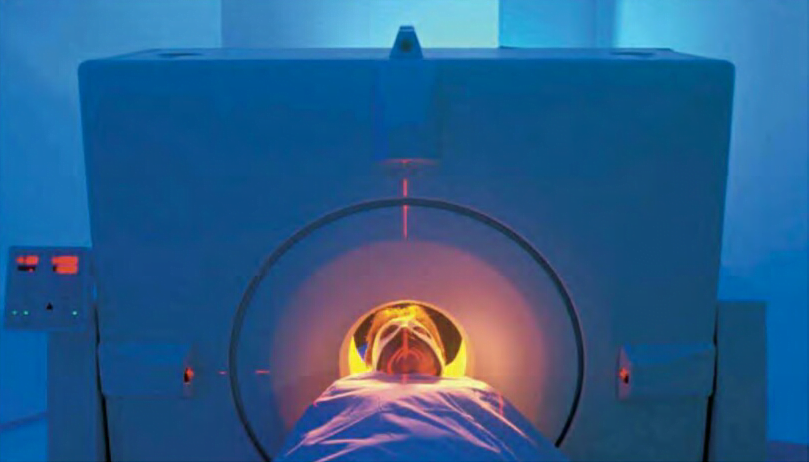
A patient receives a PET scan to pinpoint regions of the brain that are most active.

True to the rational and observational methods of Descartes and Willis, science has made great strides in describing how the brain’s parts, both large and small, function. But understanding any organ that is “wider than the sky” is not as easy as toting up small pieces of information. The brain is an integrated unit, with its complexity arising from the synergy created by the simultaneous functioning of its billions of neurons and trillions of synapses in nonlinear ways. Science has learned much about movement, sensations, emotions, and the sense of self. Yet much is yet to be gleaned about the most complicated object in the universe. There will always be more to learn about the brain.

BRAIN MAPPING [ LOOKING INSIDE ( THE AMAZING BRAIN ) ]

BRAIN MAPPING [ LOOKING INSIDE ( THE AMAZING BRAIN ) ]

Magnetic resonance imaging (MRI) gives a more detailed 3-D picture than a CT scan. An MRI relies on an intense magnetic field generated in a cylinder that surrounds the patient. It allows precise mapping of the physical shape of the brain. Its magnetic field is so powerful that it causes some of the atoms inside the brain to jerk into alignment. Then a series of radio waves from the MRI scanner bounce off the affected atoms and push them slightly out of line. When the energy from the radio signals is turned off, the atoms move back into their magnetic alignment, emitting telltale energy patterns along the way.

Addictive drugs work by mimicking neurotransmitters or altering their work. Brain scans reveal physical changes in the synaptic activity of a drug user. The drug known as Ecstasy, for example, can permanently damage neurons that produce serotonin.

Computers read these minuscule bits of energy and assemble images of cross-sections of the brain. Slices can be placed atop each other, like the layers of a cake, to represent the entire brain in three dimensions, or they can be examined individually, providing a closer look at localized phenomena. Comparisons of MRI scans of a single brain over time can show its growth-or reveal its deterioration.

BRAIN MAPPING [ LOOKING INSIDE ( THE AMAZING BRAIN ) ]

WHEN THE DENTIST asked British philosopher Bertrand Russell where he felt pain, Russell replied, with humor and honesty, “In my mind, of course.” Russell knew the brain uses the senses to collect data about the world and construct a version of “reality.” Whether that world actually exists independent of the mind makes little difference to the sufferer of a tooth- ache-the pain hurts just the same. In fact, some philosophers, such as George Berkeley (1685-1753), have questioned whether “reality” exists.

In addition to mere structure, an MRI can also capture a snapshot of thought. A variation called a functional MRI, or f-MRI, builds upon the fact that a blood cell’s magnetic properties change according to how much oxygen it contains. Receptor cells use oxygen as they take in signals from surrounding cells; burning oxygen causes cells to require more oxygen-rich blood. As blood surges toward neurons where synapses are firing with thought, emotion, or other impulses, the oxygen they carry gives off a traceable signature of radio waves. Different thoughts light up different areas of the brain in an MRI. The processes of peaking, reading, appreciating humor and music, and recognizing faces illuminate various groups of neurons. MRI techniques thus help localize areas associated with certain brain functions.