The enhancement and pruning of neural networks occurs most apparently as the baby begins to develop language. Spoken languages can sound very different from each other. In all, human languages produce about 200 different spoken sounds, called phonemes. Spoken English contains just over one-sixth of those possible sounds.
A Japanese-language keyboard suggests some of the potential complexity of learning language.
Brain scans of newborns reveal that in the first few months of life, their brain recognizes the subtle differences in phonemes other than those spoken at home. Japanese infants easily recognize the difference between the sounds made by the letters R and L. However, as the Japanese language has no sound like the letter L, adults raised speaking Japanese lose their ability to distinguish it from the letter R. Similarly, English speakers learning Spanish as adults struggle to separate the subtle sounds of the letters Band P in spoken Spanish.
But babies are able to tell such differences. That’s why it’s far easier to learn a variety of languages as a child. However, as infant brains focus on processing the auditory signals of their native languages, starting at about age 11 months they lose their ability to differentiate some nonnative phonemes. Children and adults who learn new languages after having undergone “phoneme contraction” speak with an accent.
By the time a baby is three or four months of age, its behavior provides clues to its having reached new milestones in brain development. At that age, individual infants differ widely in their reaction to events and in their patterns of brain activity as measured in EEG scans.
Rs & Ls
JAPANESE WHO BEGIN studying the English language as adults struggle with the sound of the letters Rand L. It’s not the tongue that’s to blame-it’s the brain. Newborns can distinguish all phonemes, or language sounds. Between six months and one year of age, however, children lose the ability to process previously unheard language sounds. Their loss is called phoneme contraction. Since the Japanese language slurs Rand L phonemes, adults who are exposed to the separate sounds in English for the first time cannot hear, or articulate, the difference. It’s the same for English speakers learning Japanese. They can learn the words, but it’s too late for the neuronal circuits to get the sounds exactly right.
A pattern of responses known as behavioral inhibition, which includes shyness and fear when exposed to new people and experiences, occurs in one in five healthy four month olds. Their brains show higher levels of electrical activity in the right frontal lobes. Likewise, older babies who cry upon being separated from their mother have more activity in the prefrontal cortex of their right hemisphere than do children who remain calm when mom disappears from sight.
ALBERT & THE RAT
IN A 1913 manifesto, John B. Watson introduced the term behaviorism, which, he wrote, eliminated the “dividing line between man and brute” in asserting that emotions are determined not by DNA but by external stimuli. Watson built on Ivan Pavlov’s foundation of conditioned stimulus response. Foreshadowing the 1932 publication of Aldous Huxley’s novel Brave New World, Watson theorized that “man and brute” alike can be made to order. He guaranteed, for instance, to rear any of 12 random infants to take on the occupation of his choosing. Yet Watson is remembered most, perhaps, for instilling in an infant boyan irrational fear of all things white and furry.
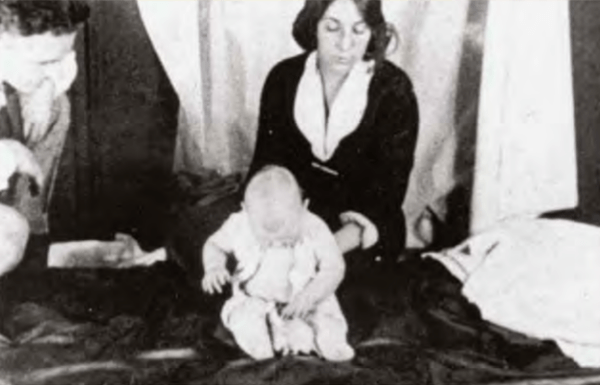
An 11-month-old called Little Albert plays his part in a famous behaviorist experiment.
In 1919, Watson began to work with 11-month-old Little Albert, conditioning him to fear a white rat. To begin with, Albert liked his pet, trying to touch and even hold it. Watson believed this reflected a curiosity innate in all children. Later, a new stimulus was introduced: When Albert reached for the rat, Watson banged a metal bar with a carpenter’s hammer. Albert fell face-forward on the mattress, whimpering. The rat was shown repeatedly, with gong and without, until Little Albert’s congenital fear of loud noises was transferred to the rat. This phobia, Watson later learned, applied also to white rabbits, dogs, a fur coat, and even a Santa Claus mask. Presumably, Watson wrote, Albert could eventually become unconditioned, but the boy was adopted before further experiments could be performed.


You must be logged in to post a comment.