Category Archives: FIRST GLIMPSE / A BETTER LOOK / COMPUTERIZED VISIONS [ THE AMAGING BRAIN ]

SEEING THOUGHTS [ LOOKING INSIDE ( THE AMAZING BRAIN ) ]

SEEING THOUGHTS [ LOOKING INSIDE ( THE AMAZING BRAIN ) ]

SEEING THOUGHTS

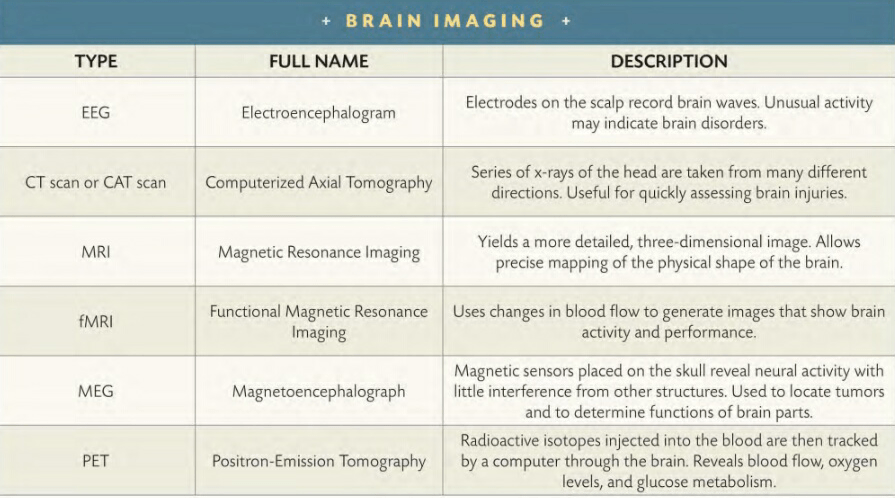
MAGNETOENCEPHALOGRAPHY ( MEG ) also relies on magnetism to examine the brain. In this case, it’s the body’s ambient magnetic fields, not those generated by an external machine, that form the basis of brain imaging. These magnetic fields are extremely weak-perhaps only a billionth of the power that causes a compass needle to point toward the north magnetic pole. Yet, when read by sensors placed on the skull, MEG scans reveal the electrical currents created by neural discharges. The resolution is as fine as a thousandth of a second and as small as a cubic centimeter. The MEG scan and EEG are the only observational techniques capable of anything approaching real-time revelations. When a patient thinks a specific thought, it shows up, in progress, on an MEG.

Mental functions also can be localized with a technique called positron-emission tomography, or PET. A radioactive isotope is injected into a patient. Because all radioactive atoms decay into stable atoms at a known rate, the decay of the isotope, which is usually paired with glucose, is recorded and turned into images with computer programs. Like MRI and CT scans, PET scans let observers localize activity inside the brain.

The array of brain-imaging techniques serves like the variety of hammers, saws, and other tools in a mechanic’s toolbox. A scientist observing the brain chooses the right tool based on what kind of information is needed. A CT or MRl scan would be the choice if a doctor suspects the growth of a tumor or physical damage to part of the cerebrum. A PET scan might be the appropriate choice for investigation of deficiencies associated with language or reason. And lack of oxygen use in stroke- damaged sections of a brain would call for a functional MRI.
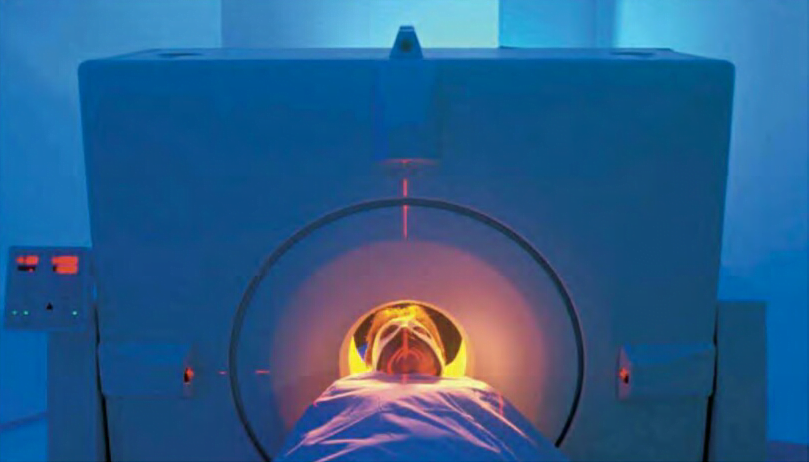
A patient receives a PET scan to pinpoint regions of the brain that are most active.

True to the rational and observational methods of Descartes and Willis, science has made great strides in describing how the brain’s parts, both large and small, function. But understanding any organ that is “wider than the sky” is not as easy as toting up small pieces of information. The brain is an integrated unit, with its complexity arising from the synergy created by the simultaneous functioning of its billions of neurons and trillions of synapses in nonlinear ways. Science has learned much about movement, sensations, emotions, and the sense of self. Yet much is yet to be gleaned about the most complicated object in the universe. There will always be more to learn about the brain.
FIRST GLIMPSE / A BETTER LOOK / COMPUTERIZED VISIONS [ THE AMAGING BRAIN ]

FIRST GLIMPSE / A BETTER LOOK / COMPUTERIZED VISIONS [ THE AMAGING BRAIN ]

FIRST GLIMPSE

The first technology to peer into the brain was the x-ray, invented by Wilhelm Rontgen (1845-1923) in 1895. The German scientist discovered a form of radiation that could penetrate the body; the rays were absorbed by dense bones, which then appeared as shadows on film.

When applied to the brain, simple x-rays, harnessed to make photographic images of bone, permitted doctors to make a basic examination of the structure of the head. However, x-rays give only a two-dimensional view, and show relatively little of the soft tissues of organs. As the human brain is a three-dimensional object, whatever appeared in a 2-D image usually was murky and confusing. Often, structures lying in different planes of the brain overlapped each other, making analysis difficult.

A BETTER LOOK

Scientists first peered at real-time brain functions in 1929 with the invention of the electroencephalogram, or EEG. Electrodes fitted to the scalp record electrical activity within the brain as neurons discharge. Unusual brainwave activity registered on an EEG may indicate brain disorders. This technique records electrical activity in real time.

More recently, scientists have employed a variety of tools to get a more detailed and localized look at structure and action inside the brain.

COMPUTERIZED VISIONS

Computerized axial tomograms, or CT scans, have substantially improved the ability of x-rays to probe the secrets of the brain. A patient receiving a CT scan lies inside a doughnut-shaped array of sensitive detectors while a movable x-ray emitter rotates around the brain. Computers convert the images into a three-dimensional image of the brain. Slices of the interior-the word tomos is Greek for “section”-can be teased from the data and shown on a screen to give doctors a narrow look at particular points in the brain. For example, a CT scan might reveal a tumor located deep inside the tissue of a living brain, far too deep to be visible during routine exploratory surgery.

THE AMAZING BRAIN

SWEDISH SCIENTISTS in 2008 created the illusion of shaking hands with yourself. They had volunteers and a mannequin wear virtual reality goggles Images in the volunteers’ goggles came from the dummy. Most test subjects felt the weird sensation of the dummy’s point of view when shaking their own hands.