The enhancement and pruning of neural networks occurs most apparently as the baby begins to develop language. Spoken languages can sound very different from each other. In all, human languages produce about 200 different spoken sounds, called phonemes. Spoken English contains just over one-sixth of those possible sounds.
A Japanese-language keyboard suggests some of the potential complexity of learning language.
Brain scans of newborns reveal that in the first few months of life, their brain recognizes the subtle differences in phonemes other than those spoken at home. Japanese infants easily recognize the difference between the sounds made by the letters R and L. However, as the Japanese language has no sound like the letter L, adults raised speaking Japanese lose their ability to distinguish it from the letter R. Similarly, English speakers learning Spanish as adults struggle to separate the subtle sounds of the letters Band P in spoken Spanish.
But babies are able to tell such differences. That’s why it’s far easier to learn a variety of languages as a child. However, as infant brains focus on processing the auditory signals of their native languages, starting at about age 11 months they lose their ability to differentiate some nonnative phonemes. Children and adults who learn new languages after having undergone “phoneme contraction” speak with an accent.
Some scientists argue that as the brain incorporates new experiences and makes new connections among neurons, it expresses a form of evolution through the competition of its various neural networks. Nobel Prize-winning neuroscientist Gerald Edelman suggests that the brain’s many networks vie against each other in “neural Darwinism.”
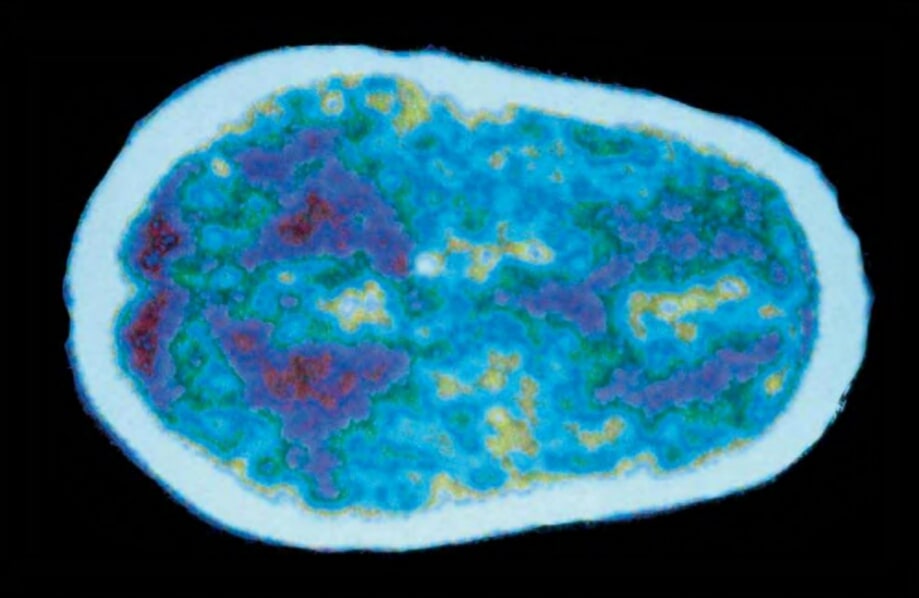
A newborn’s brain (seen above in an MRI) is ready to begin making, remaking, and pruning neural connections by the million.
While genes determine how the brain begins to grow in an embryo, the brain’s extreme complexity and plasticity make it nearly impossible to predict how it will develop in response to a particular stimulus. The complexity of the brain makes it like the weather. Short-term weather forecasts are possible with some degree of confidence, but long-range forecasts become more and more difficult because of the interaction of so many variables. The so-called butterfly effect, which was discovered during computer generated weather simulations in the 1960s, posits that under the right conditions, the flapping of a butterfly’s wings in China can be magnified until it causes a tornado in Texas. As expressed in the brain, a small change in biochemistry under sensitive conditions may have a tremendous impact on the brain’s future development.
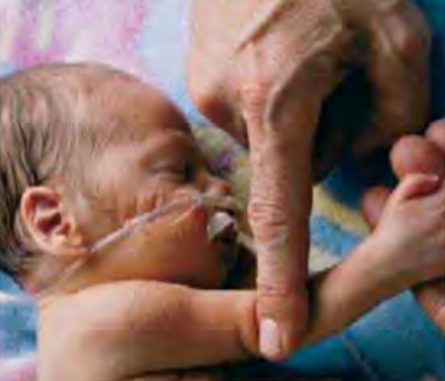
PREMATURE births pose special challenges to the brain. The child emerges from the womb before its neural networks have been established and have gone through initial stages of pruning. Much of the brain development must occur in the buzzing confusion of the world rather than a calm womb, which psychologist Sigmund Freud called the baby’s stimulus barrier. Development of the preemie’s brain occurs without the nutrients and protection of the uterine environment. In addition to difficulties involving regulation of body temperature, digestion of food, and weakened breathing, many preemies suffer brainhemorrhage. Babies who survive amid the chaos of lightsand sounds in a hospital nursery may have their brain overstimulated and may develop problems such as attention disorders and learning disabilities later in life.
Brigham and Women’s Hospital in Boston has attempted to re-create the conditions of the womb in its neonatal intensive care unit. A preemie’s brain reacts with extreme sensitivity to light and loud noises, so the hospital keeps its NICU dark and quiet. Babies get plenty of skin-to-skin contact, to mimic the touch of the womb. They feed on demand. And they’re allowed some freedom of movement, as they would experience inside the womb, rather than being swaddled tightly The result: These babies leave the hospital earlier than those raised in a standard intensive care unit and have an accelerated developmental curve compared with other preemies.
Consider how neural Darwinism finds expression in the early stages of fetal brain growth. Neurons forming from stem cells move through the brain, guided by basic genetic coding. Genes determine how the neurons connect, axon to dendrite, to create the foundation and basic architecture of the brain. However, the precise chemical environment surrounding the newly formed neurons strongly influences how far they migrate and which neighboring neurons they link with. Exposure to substances in the womb, such as alcohol, can disrupt neuronal migration, but there is no guarantee that exposure will or won’t lead to fetal alcohol syndrome. The unpredictability of the complex system that is the human brain makes such precise calculations impossible.
Toys and a mentally stimulating environment help a baby’s brain grow complex neural connections.
Babies don’t learn to walk until about a year after birth, but they are born with the neural program already hardwired.
As people grow older, they take in new experiences. There may be changes in climate, social networks, formal education, and career. To get on in life, people have to adapt to change. Successful adaptation is a matter of rewiring the brain by creating new neuronal connections. Links that promotesurvival and well-being grow stronger. Those that lose their usefulness grow weaker. In a process that resembles natural selection, they lose the competition to stronger neural networks, and they die.
Neural Darwinism provides a new perspective on the brain’s plasticity: As neural networks compete, those that function best get stronger. Changes in the environment encourage changes in the brain by giving new neural networks a chance to flourish. Such evolution of a single brain continues over an entire lifetime.
As a baby emerges from the womb, brain development expands to include processing responses to the baby’s new experiences sights, sounds, smells, actions, sensations, and emotions. Networks of neurons, primed to receive new stimuli,compete for survival. It’s a random battle at first, but soon becomes more organized as environmental stimuli strengthen some connections while others wither. If the baby is exposed to a broad vocabulary and a wide range of music, the connections for language and sound recognition grow stronger. If the baby is kept in an environment lacking in toys and visual stimulation, the baby’s analytical powers may be slow to develop.
ESTABLISHING NETWORKS
Defects in infants’ eyes illustrate the sensitivity of a newborn’s brain and the competing neural networks. When a child is born with a cataract in one eye, that eye is deprived of normal vision, and the portion of the brain that processes information from that eye suffers lack of stimulation. The baby’s one normally functioning eye begins to process all visual information.
NEWBORN SIGHT
WE CAN’T KNOW for certain what the world looks like to a newborn; babies don’t answer interviewers’ questions. However, scientists who study the makeup of new-borns’ eyes and test for whether babies will gaze at objects believe that for the first months of life, children lack the ability to see fine lines and a full spectrum of colors. The world probably looks like a blurred, faded photograph as seen through a card-board tube.
New-borns appear to be hardwired for looking at faces. Shortly after birth, infants will look at faces longer than they will look at any other object.
The “use it or lose it” principle starts to work-with a vengeance. Neural connections develop for the good eye but fail to do so for the eye with the cataract. Unless the cataract is removed shortly after birth, the child will remain blind in that eye. Even if the cataract is removed later, the brain has lost its one chance to develop the neural circuitry to process visual signals from the eye; the eyeball may appear healthy, but it cannot communicate with the brain.
If surgery removes the cataract in time, the strong, already existing neural connections of the stronger eye give it a favored place in brain development. In order to make both eyes work with the same acuity, doctors often patch the stronger eye for a few hours every day. That way, for extended periods, all of the neural development for vision is processed via the weaker eye. Its brain circuitry grows stronger by not having to compete all the time with the good eye.
The process of establishing and strengthening connections in the brain to process vision underscores the fact that certain periods are absolutely critical to proper functional development. While the brain retains a measure of plasticity among existing networks, it also seldom offers a second chance for establishing those networks at an early age. In other words, the brain cannot expand and reconnect a neural network that doesn’t exist or one that exists, like a dead-end road, without functional traffic.


![NEWBORN NEURONS [ BRAIN ]](https://humanityuapd.com/wp-content/uploads/2022/12/20221206_164529_0000-1024x1024.png)

You must be logged in to post a comment.