Category Archives: DEGREES OF PAIN [ THE NERVOUS SYSTEM ]

HEADACHES ( THE BRAIN’S EQUILIBRIUM )

HEADACHES ( THE BRAIN’S EQUILIBRIUM )

HEADACHES In the waning days of the Civil War, Union general Ulysses S. Grant was suffering from a terrible headache. He stopped at a farmhouse in the rear of his army, which had been pressing the forces of Confederate general Robert E. Lee. “I spent the night in bathing my feet in hot water and mustard, and putting mustard plasters on my wrists and the back part of my neck, hoping to be cured by morning,” Grant wrote in his journal on April 9, 1865.

Shortly afterward, Grant was visited by a messenger who carried a note saying Lee, who had refused to surrender the previous day, had changed his mind and would be willing to meet to discuss a formal end of hostilities. “When the officer reached me,” Grant said, “I was still suffering from the sick headache; but the instant I saw the contents of the note I was cured.”
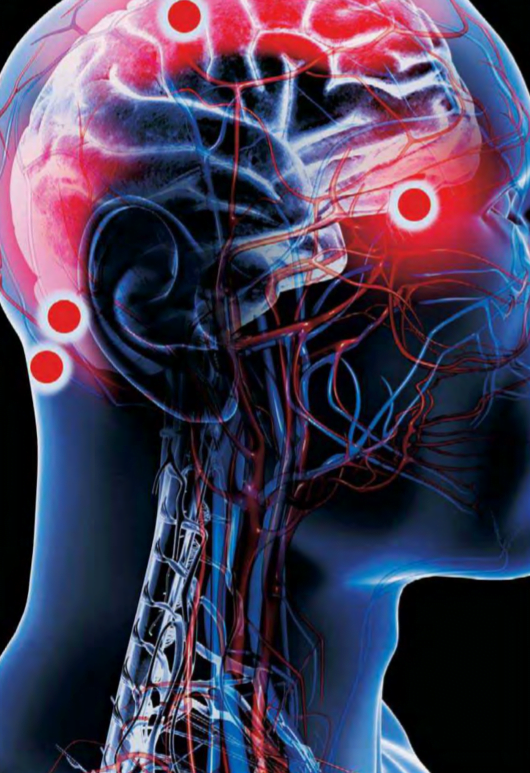
Red indicates pain in a map of common headache sites, none of which is in the brain itself

Grant probably suffered from a muscle-contraction, or “tension,” headache. Typically, a tension headache begins when the neck, scalp, and face muscles are tensely held stiff for a long time. The most usual source is prolonged anxiety, a debilitating form of stress. Grant needed Lee to surrender; Lee’s announcement of his plans took the worries, and the agony, away. “The pain in my head seemed to leave me the moment I got Lee’s letter,” Grant reportedly told an aide as he rode off to end the war.

HEADACHES CATEGORIES

Even as it serves as an indicator that homeostasis is being disrupted, a headache is not a disease per se. Instead, it maya symptom of some other problem. It can manifest itself in response to irritation of blood vessels in the head, or to an injury or imbalance, or to inflammation of bodily tissues, to disorders related to stress-or to a host of other possible triggers. While it may feel as if the brain screams in pain, a headache can only occur outside the brain itself, which contains no pain receptors.

Headaches come in dozens of varieties. An easy way to categorize them is by the ways they cause pain. Muscle contractions such as Grant’s are one of the most common sources, especially among those living with high levels of stress. Dilation of blood vessels is a second typical cause. When arteries expand in the head, they squeeze against surrounding tissues, producing viselike pressure and pain. Fever, migraines, drug reactions, changes in blood pressure, and carbon dioxide poisoning can provoke dilation. Internal traction an abnormal growth in the head, for example is a third trigger. When a tumor presses against other tissues, or the brain itself begins to swell, the pressure causes pain. Inflammation is a fourth common source. Allergic reactions and infections such as meningitis can irritate pain-sensitive receptors in the head. Finally, headaches can occur without an obvious physical cause. These headaches are called psychogenic, meaning they arise in the psyche. They may spring from an emotional problem, as the sufferer converts emotional pain into real, physical symptoms.

The word migraine evolved from the Greek word hemikrania, meaning “half-skull.”
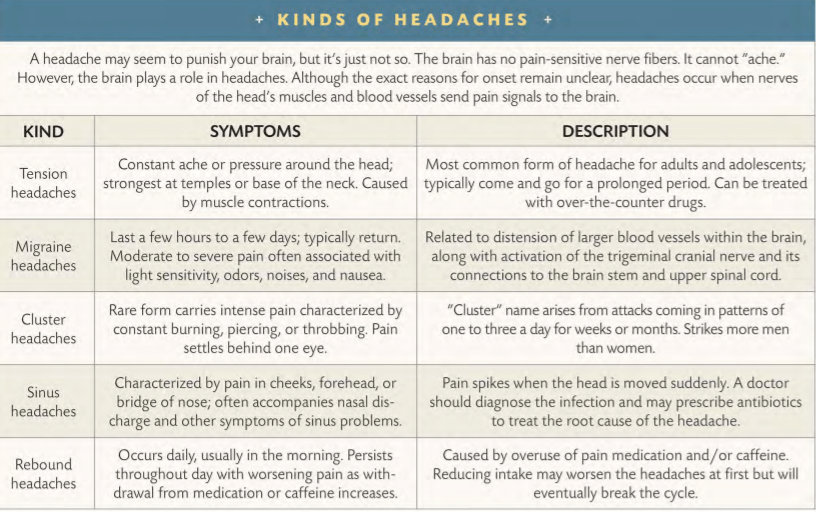
HEADACHE CATEGORIES

Many of these disorders strike not next to the brain, but in the eyes, sinuses, and other facial organs and tissues. Cranial nerves intimately connect the face and neck muscles to the brain, so it is no wonder pain sensations can spread until they feel as if they overwhelm the entire head.

Treating chronic headaches requires a proper diagnosis. Given the wide range of headaches and their causes, as well as the possibility of triggers working in combination, medical treatment often relies on detective work. At least, however, the efficacy of treatment has advanced since humanity first tried to cure a headache. A thousand years ago, Arabs recommended applying hot irons to the head, while a French medical treatise written in Latin urged sufferers to mix the brain of a vulture with oil and shove it up the nose. Today, modern pharmaceuticals, relax- ation techniques, and proper diet target dilation, tension, and other causes. One of the most effective pain relievers is common aspirin.

GOOD FEELINGS / PLEASURE CENTERS [ THE NERVOUS SYSTEM ]

GOOD FEELINGS / PLEASURE CENTERS [ NERVOUS SYSTEM ]

GOOD FEELINGS

Pleasure also has its centers In the brain. A Tulane University neurologist stumbled across one such center in the 1950s when he tried to electrically stimulate the brains of schizophrenics to break them out of their passivity. His patients told him their implanted electrodes created pleasant sensations. The neurologist, Robert G. Heath, seized upon the results, focused his attention on the brain’s pleasure centers, and published the 1964 book The Role of Pleasure in Behavior.

Together with the discovery of pain centers in the brain, research on the physical causes of the sense of pleasure seemed to prove the ancient wisdom that humans seek to act in ways that bring them pleasure and reduce or avoid pain. New paths of investigation have led to innovative treatments for addiction, which is a form of behavior based on compulsive forms of pleasure seeking. PET scans reveal how drugs such as cocaine and heroin activate the brain’s pleasure centers. Cocaine, for example, blocks a neuron’s reuptake mechanism, which causes dopamine to linger in the synaptic cleft.

PLEASURE CENTERS

Joy, happiness, pleasure-what-ever you want to call the positive feelings that bring rewarding sensations and make life worth living-arise from the sensations of security, warmth, and social well-being combined with an awareness of the rightness of such feelings. A healthy brain recognizes the conditions that give rise to pleasure and responds to them appropriately. An unhealthy brain, or one that has learned negative behaviors such as addiction, can miss out on experiencing life’s joys. Both are primarily a matter of chemistry.

GOOD FEELINGS / PLEASURE CENTERS [ THE NERVOUS SYSTEM ]

The sensation of pleasure registers in several brain regions, including significant centers in the hypothalamus and nucleus accumbens , which lies below a portion of the basal ganglia linked to movement. All such pleasure centers rely on the chemical work performed by endorphins and neurotransmitters, particularly dopamine, to create and sustain a happy mood. Experiments with rats have demonstrated the key role of dopamine. In the 1950s, scientists wired rats’ brains so that when they pressed a bar, they received a mild electric shock to the hypothalamus. This stimulation registered as pleasure; the rats would rather press the bar than eat. However, in later experiments, rats wired for self-stimulation first received injections of drugs that block the receptors where dopamine normally binds, denying its pleasure-giving action. The rats no longer felt a pleasant reward from pressing a lever to stimulate their brain, and they stopped doing so. When humans take a similar dopamine-lowering medication, often in order to ward off hallucinations and other psychotic behavior, the drug’s success comes at a price. Delusions may leave, but so do joy and motivation. Conversely, drugs like amphetamines that increase the activity of dopamine in the brain lower the threshold for the perception of pleasure. Too much of a drug-induced pleasant sensation, however, can lead to addiction and manic moods.

When the skin warms, the sympathetic division of the autonomic nervous system dilates blood vessels near the surface and activates the sweat glands. When body temperature cools, the autonomic nervous system narrows surface vessels to send blood to deeper, more vital organs.

“The greatest pleasure of life is love,” said the Greek playwright Euripides nearly 2,500 years ago. Like other forms of pleasure, love is processed by brain chemistry, specifically by heightened levels of neurotransmitters in the pleasure centers. MRI scans of the brain relate the feeling of lust to estrogen and androgens; attraction-more emotional than physical-appears to be associated with serotonin and dopamine. The brain chemistry that supports long-term relationships such as lifelong commitment has been harder to pin down.

Playing key roles in the sensation of pleasure are oxytocin, endorphins, and phenylethylamine , or PEA, sometimes called the love drug. These chemicals help foster the “high” felt in the first stages of love, as well as the euphoria some-times reported by long-distance runners. Even a small pleasure, such as finding your lost car keys, begins with a tiny rise of these and similar neurotransmitters in the brain’s pleasure centers.

DEGREES OF PAIN [ THE NERVOUS SYSTEM ]

DEGREES OF PAIN [ THE NERVOUS SYSTEM ]

Similar pains don’t always register with the same intensity. Although nearly all humans-besides the very few who lack the ability to feel pain recognize extreme heat or a deep cut as painful, they can react differently. Some tolerate pain more easily, whereas others feel it more intensely. Physical, cultural, and psychological variables may also influence a person’s individual degree of pain tolerance.

Cultural and psychological influences on an individual’s tolerance of pain are more ethereal and hard to measure than physiological influences. During World War II, British soldiers injured in the brutal fighting at Anzio, Italy, in 1943 routinely refused morphine to kill their pain, while civilians who suffered far less serious wounds demanded it to ease their pain. The surgeon who noted the difference came to the conclusion that certain kinds of pain could be a matter of mind, not of the body.

Ritual mortification of the flesh at the Hindu festival of Thaipusam in Malaysia demonstrates the power of brain over pain.

Long-term, intense pain can create a different perception in the brain. This chronic sensation may confuse the central nervous system and result in hyperalgesia, or pain amplification. Such pain registers on the same kind of synaptic receptors that are activated during certain kinds of learning. Under the worst- case scenarios, the chronic pain causes the spinal cord to “learn” hyperalgesia, and pain’s sensitivity increases. Examples include the lingering pain of phantom limbs-the sensation of pain from an amputated arm or leg.

Neural networks that process stimuli from a limb remain primed to respond to signals even after it’s gone. Random signals may get misinterpreted as tingling, itching, pain, or some other sensation. Neuroscientist Vilayanur Ramachandran found he could create sensations in phantom limbs by applying pressure to various skin surfaces. His conclusion: The cerebral cortex relocated sensation pathways associated with the old limb. These pathways may always have existed in a weak state, but loss of the limb amplified them. Unfortunately, neural networks that continue to recognize “pain” signals from a missing limb become more strongly primed to repeat the mistake. Treatments for phantom pain range from drug therapy to acupuncture and deep brain stimulation. Newer treatments, using mirrors or virtual reality goggles, trick the brain into thinking it can control the amputated limb.