
Tag Archives: Continuous Learning

Articles | Easy English Course in 28 days | Absolutely Free

Articles

Articles

In the English language, articles are essential components that serve to clarify the specificity and definiteness of nouns. They function as determiners, providing crucial information about the nouns they precede. Essentially, there are two types of articles: definite articles and indefinite articles. Understanding how these articles operate within sentences is vital for grasping the nuances of English syntax.

The definite article, “the,” indicates a specific noun that is known to the reader or listener. For example, in the phrase “the book on the table,” the article specifies which book is being referred to, implying that it is a particular book familiar to both the speaker and the audience. This specificity is pivotal in ensuring clear communication.

On the other hand, indefinite articles, which include “a” and “an,” refer to non-specific nouns. They are used when the exact identity of the noun is not crucial or when it is being mentioned for the first time. For instance, saying “a dog barked” introduces the idea of any dog rather than a specific one. Such distinctions play a significant role in conveying meaning accurately.

The use of articles not only aids in avoiding ambiguity but also enriches the English language by allowing greater flexibility in expressing both general and specific ideas. Articles contribute to the syntactic structure of sentences, enabling speakers and writers to convey their thoughts with precision.

Overall, a solid understanding of articles and their proper usage is fundamental for anyone learning English. Mastering this aspect of grammar aids in effective communication, ensuring that messages are delivered clearly and succinctly.

Adverbs | Learn English absolutely free | english.humanityuapd.com

What Are Adverbs

What Are Adverbs?

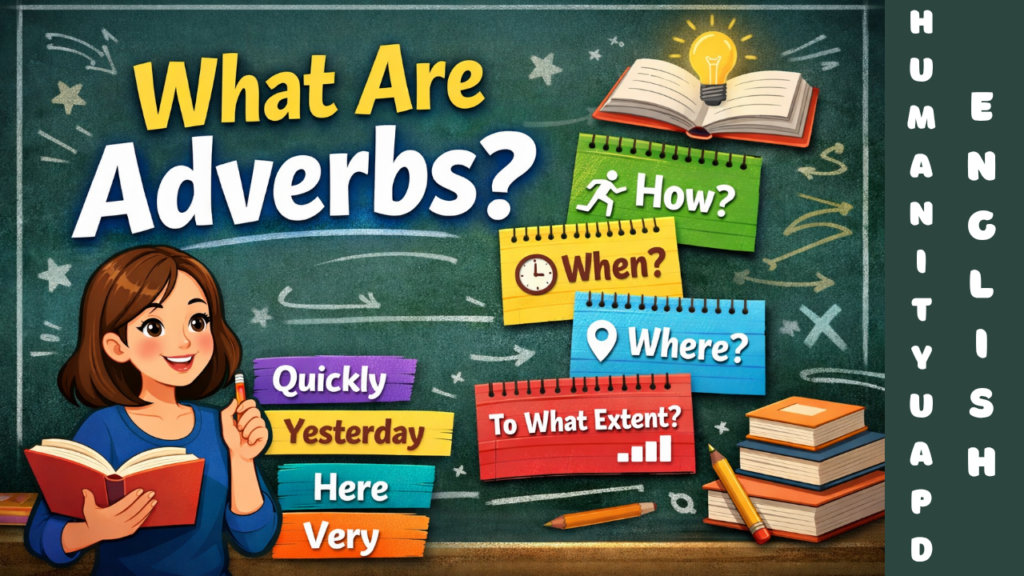
Adverbs are a crucial part of speech in the English language, serving the essential function of modifying verbs, adjectives, and even other adverbs. By definition, adverbs provide additional information about how, when, where, and to what extent an action is performed, adding depth and clarity to sentences. This modification can enhance the reader’s understanding of the action or description being conveyed.

Typically, adverbs can be identified by their ability to answer specific questions such as “how?”, “when?”, “where?”, and “to what extent?” For instance, if one considers the sentence “She ran quickly,” the adverb “quickly” modifies the verb “ran” by specifying the manner in which the running occurred. This enhancement illustrates the importance of adverbs as they significantly influence the meaning of the action being described.

Additionally, adverbs can also modify adjectives, which underscores their versatility. For example, in the phrase “very tall,” the adverb “very” modifies the adjective “tall,” indicating the degree of tallness described. Similarly, adverbs can modify other adverbs, as seen in the phrase “extremely quickly,” where “extremely” augments the meaning of the adverb “quickly.” This ability to modify multiple parts of speech is vital for articulating complex ideas and emotions succinctly.

In summary, adverbs play a significant role in grammar by determining the nuances of meaning in communication. Their capacity to modify various components within a sentence not only enriches the language but also allows for precise and vivid expression. Understanding how adverbs function is fundamental for mastering effective writing and comprehension in the English language.