Tag Archives: Free tools

Calculate Work Hours and Time Duration Easily

Calculate Work Hours and Time Duration

Calculate Work Hours and Time Duration

Accurate calculation of work hours and time duration is essential in both personal and professional settings. Developing a keen understanding of how to track and manage time can significantly affect productivity levels and overall efficiency. In various sectors, understanding work hours helps in allocating tasks appropriately, setting realistic deadlines, and assessing employee performance.

Furthermore, effective time management ensures that individual goals align with organizational objectives. For instance, in a professional environment, accurately recording hours can lead to timely project completions, reduced operational costs, and enhanced job satisfaction among employees. Employees who manage their time well tend to have clearer priorities and greater focus, which translates into higher output and innovation.

In personal contexts, knowing how to calculate time duration can help individuals balance their personal commitments alongside professional responsibilities. Mismanagement of time can lead to feelings of overwhelm and stress, while proper scheduling can contribute to a healthier work-life balance. Thus, proficiency in calculating hours spent on various tasks or projects not only fosters greater awareness of time usage but also aids in identifying areas where improvements can be made.

Moreover, the incorporation of technology such as time-tracking applications and digital calendars has simplified the process of logging and calculating work hours. Such tools enhance accuracy while providing immediate insights into time allocation. Ultimately, mastering the art of calculating work hours equips individuals with the knowledge they need to optimize their time utilization, paving the way for success in an increasingly time-conscious world.
Calculate Age Manually – Free Tools (tools.humanityuapd.com)

How to Calculate Age Manually

How to Calculate Age Manually

Calculating age is a fundamental practice with significant implications in various areas of life, from health assessments to legal requirements and personal milestones. Knowing one’s age is vital for categorizing individuals into distinct age brackets, which can affect healthcare provisions, education opportunities, and eligibility for certain legal rights and obligations. Whether it is for registering a child for school, applying for a driver’s license, or advancing through life stages, accurate age calculation plays an essential role.

There are numerous methods utilized for determining age, ranging from simple calculations using birthdates to more complex algorithmic approaches. While there are digital tools and online  calculators available to perform these computations swiftly, understanding how to calculate age manually is beneficial for situations where technology may not be accessible. Additionally, manual calculation enhances one’s numerical and analytical skills.

This blog post will focus on the step-by-step process to calculate age manually. The method involves straightforward arithmetic, where the current date is compared to an individual’s birth date. We will explore different scenarios that might come into play, such as leap years and varying days in months, to ensure accurate age determination. By fostering clarity on manual age calculation, individuals will be better equipped to handle situations where precise age is a prerequisite.

In the sections that follow, we will delve deeper into the methodologies for manual age calculation, illustrating the importance of each step in achieving an accurate age outcome. Understanding this process not only enhances one’s capability to determine age but also underscores its relevance across numerous settings in daily life.

Body Mass Index (BMI) – Free Tools (HUMANITYUAPD)

BMI (Body Mass Index)

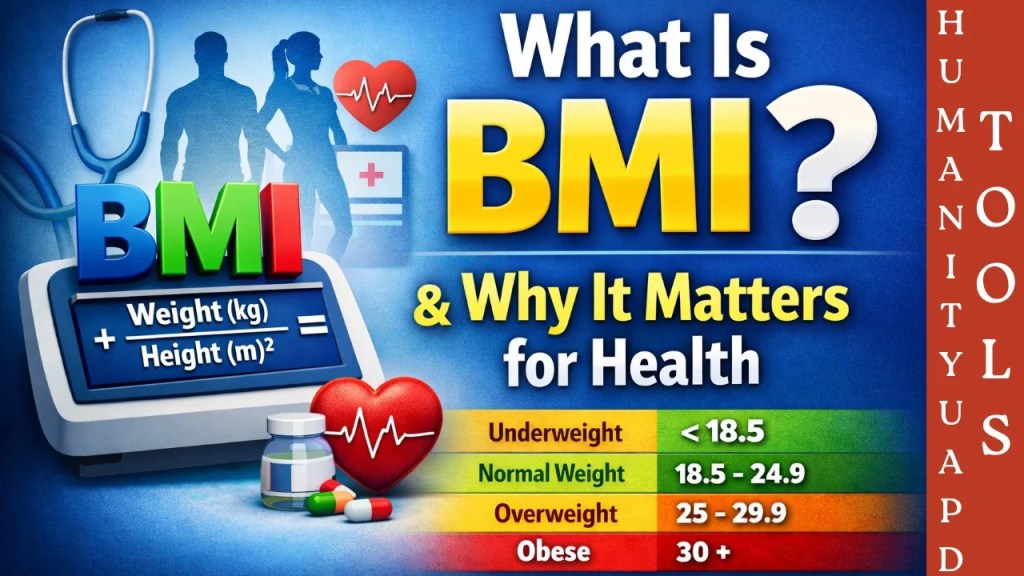
Body Mass Index, commonly referred to as BMI, is a widely used tool designed to assess body weight relative to height. The calculation is straightforward; it divides an individual’s weight in kilograms by the square of their height in meters. The formula is represented as follows: BMI = weight (kg) / (height (m) x height (m)). This simple mathematical equation provides a numerical value that can indicate a person’s weight status, which may be categorized as underweight, normal weight, overweight, or obese.

The origins of BMI date back to the 1830s when the Belgian mathematician Adolphe Quetelet developed this index to study the relationship between weight and height in the general population. Although initially intended for statistical purposes rather than individual health assessments, BMI gained traction as a method to evaluate body weight and its association with health risks.

BMI serves primarily as a population-level measure; it is not intended for clinical diagnosis or assessment of fat distribution in an individual. However, it offers a quick way to identify potential weight-related health risks and categorize individuals for further evaluation. Public health organizations, including the World Health Organization (WHO), utilize BMI as a standard index for assessing overweight and obesity trends in populations, making it a vital tool in public health surveillance.

Given the wide acceptance of BMI, it is important to recognize its limitations. It does not account for factors such as muscle mass, bone density, and overall body composition. Consequently, while BMI is a useful initial assessment tool, it should be complemented by other health assessments for a comprehensive understanding of an individual’s health status.

Count Words For Essays, Blogs, and Assignments – HUMANITYUAPD

Count Words for Essays, Blogs, and Assignments

Count Words for Essays, Blogs, and Assignments

Word count refers to the total number of words contained in a written document. This metric serves a crucial function in both academic and blogging contexts, offering a standardized way to measure the length of written work. Properly understanding and managing word count is essential for anyone engaged in writing essays, blogs, or any academic assignments. In both situations, there are often specific guidelines or requirements regarding the acceptable word limit that must be adhered to.

In academic settings, word count is typically set by instructors or institutions and is intended to ensure that students engage with their topics in sufficient depth. Meeting these guidelines not only influences grading, but also reflects a student’s ability to articulate their thoughts clearly and concisely. Inadequate responses may result from insufficient word count, thereby highlighting the importance of careful planning and execution when composing an essay.

Similarly, in the realm of blogging, word count can significantly impact audience engagement and search engine optimization (SEO). Many blogging platforms recommend specific word limits to optimize readability and ensure that the material captures readers’ attention effectively. An overly short blog may fail to provide enough value or information, whereas an excessively long article could deter readers from engaging with the content. Consequently, maintaining an appropriate word count is instrumental in enhancing clarity and improving overall communication in both essays and blogs.

In conclusion, understanding the concept of word count is vital for achieving success in writing tasks. Whether for academic assessments or blogging endeavors, accurately counting words not only helps meet specified guidelines but also contributes to the overall clarity and effectiveness of the written material.

Calculate Percentage Without a Calculator | Free Tools

Calculate Percentage Without a Calculator

Calculate Percentage Without a Calculator

Percentages are a fundamental concept in mathematics that represent a part of a whole. The term “percent” originates from the Latin phrase “per centum,” which translates to “by the hundred.” When we express a number as a percentage, we are indicating how many parts of a hundred are represented by that particular number. This concept is crucial in various aspects of daily life, including finance, statistics, and general data interpretation.

In essence, a percentage provides a straightforward way to compare quantities. For example, if a school has 200 students and 50 of them are girls, you could express the number of girls as a percentage of the total student body. This would be calculated as (50/200) × 100, which results in 25%. This simple example illustrates how percentages help us to quickly understand proportions and make comparisons simpler and more intuitive.

The basic formula for calculating percentages is quite simple and can be summarized as follows:
Percentage (%) = (Part / Whole) × 100. This formula allows anyone to determine the percentage value for any given part of a whole, making it an invaluable tool for problem-solving.

Mastering percentage calculations is beneficial in numerous real-life situations. From assessing discounts during a shopping experience to calculating tips or interpreting statistical data in news articles, the ability to understand and compute percentages can significantly enhance decision-making processes. By familiarizing oneself with the concept of percentages, individuals equip themselves with a practical skill that has extensive applications in both personal and professional contexts.