Tag Archives: GROWING COMPLEXITY [ EVOLUTION ( BRAIN DEVELOPMENT ) ]

THE THREE BRAINS – MACLEAN [ EVOLUTION ]

THE THREE BRAINS – MACLEAN [ EVOLUTION ]

THE THREE BRAINS

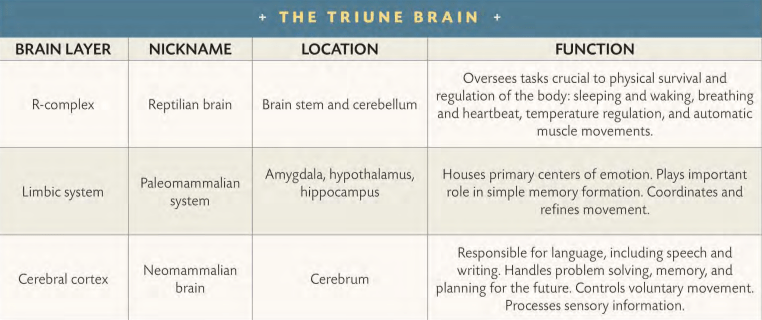
Neuroscientist Paul MacLean suggested in 1967 that the human brain functions as three separate “brains,” each of which represents a stage in evolutionary development. He referred to the three-way unity as humanity’s triune brain. Through evolution’s penchant for preserving genetic code that proves useful for survival and discarding mutations that prove useless, MacLean suggested that human brains evolved by adding to successful brain structures of earlier vertebrates. Thus, both fish and dogs have brain structures in common with people. But instead of the evolutionary structures being uniformly mixed throughout the human brain, they nest one inside another like Russian dolls. The most primitive lies deepest in the brain, under more modern layers.

Charles Darwin observed that domesticated animals have thinner cortical layers than their wild cousins in the forest. Wild animals’ exposure to a wider variety of environmental stimuli may create richer neural connections.
THE THREE BRAINS

FIRST BRAIN

MacLean’s first “brain” is the R-complex, which takes its name from its resemblance to the simple brains of reptiles. The R-complex formed from an extension of the upper brain stem. It’s enough to keep a snake or a salamander alive as well as ensure the continuation of the species. The R-complex oversees sleeping and waking, breathing and heartbeat, temperature regulation, and automatic muscle movements. It also plays a crucial role in the processing of sensory signals from the peripheral nervous system. MacLean’s experiments with a variety of animals demonstrated that the neural connections in the R-complex provide sufficient mental firepower for hunting, mating, establishing territory, and fighting. In other words, everything necessary for finding food, competing with other animals for survival, and passing along the genes of the dominant, strongest individuals. Humans may think of themselves as being far above turtles and alligators, but their brain shares the same mechanics for regulating basic body functions. Further-more, whenever humans engage in a schoolyard scuffie or compete for the affections of another, they’re exercising the reptilian cores of their brain.

SECOND BRAIN

The second “brain” is the limbic, or paleo mammalian, system. It’s common to all mammals, including humans, but is lacking in reptiles. The limbic system coordinates and refines movement. It gives rise to emotions and simple memory, as well as the rudimentary social behaviors they make possible. When MacLean destroyed part of the limbic system in the brain of young mammals, their behavior regressed toward the reptilian. They stopped playing and exhibited weaker mother-offspring bonds. Humans who flush with anger when they get slapped across the face, or glow with happiness when kissed, are using their limbic systems. If they choose to ignore the slap or the kiss, however, they need to exercise the third and highest level of the brain.
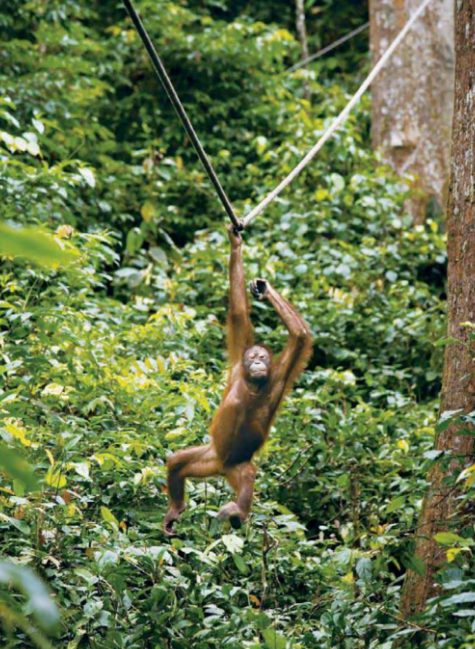
Swinging through forest has been linked in theory to brain hemisphere specialization.
THIRD BRAIN

The third “brain” is the cerebral cortex. Many mammals possess a cortex, but it is most highly developed in humans. It adds the benefits of problem solving and both long-term and complex working memory to the lower two “brains.” The neomammalian brain, as MacLean dubbed it, gives humanity its capacity for language, culture, memory of the past, and anticipation of the future. It also makes humans the first species with empathy, the ability to see the world through the eyes of others.

“It is this new development that makes possible the insight required to plan for the needs of others as well as the self … In creating for the first time a creature with a concern for all living things, nature accomplished a 180-degree turn-about from what had previously been a reptile-eat-reptile and dog- eat-dog world,” MacLean said.
EVOLUTIONARY CLUES OR PAVLOV’S DOGS

EVOLUTIONARY CLUES OR PAVLOV’S DOGS

EVOLUTIONARY CLUES

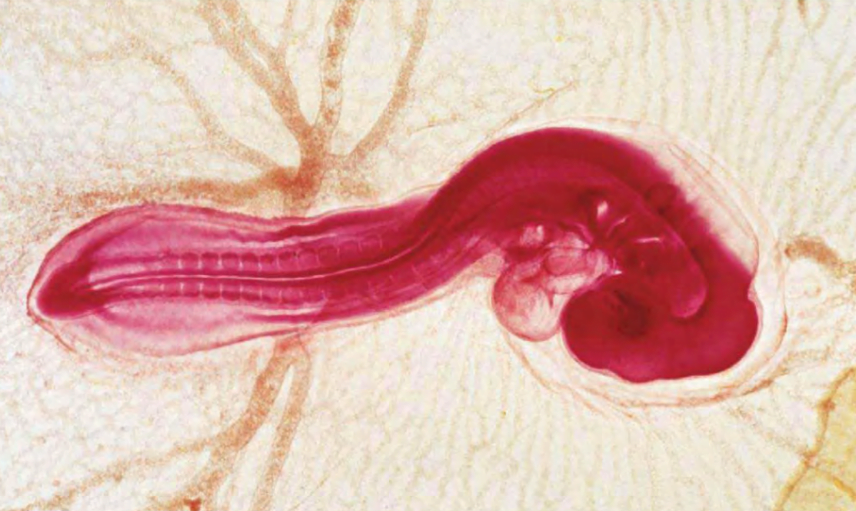
Some of humanity’s evolutionary history can be observed in the development of a human fetus. As chicken and human embryos develop, for example, they experience a stage where they both have a tail, as well as arches and slits in their neck remarkably like the gill slits and arches found in fish. Thus, scientists in the late 20th century concluded that chickens and humans most likely shared a fish-like ancestor, based not only on visual evidence but also on DNA and fossil records. Not all ancestral characteristics become evident during fetal development, but enough similarities exist to suggest an evolutionary thread.

A few days after conception, a human embryo’s cells begin to specialize. Some form a simple neural plate, which changes into a groove and then a tube. The huge cerebral cortex that distinguishes the human brain develops last, in the final months before birth, just as it evolved from humanity’s simian ancestors two million years ago relatively late on the evolutionary tree. Like an hour-long film compressed into a few seconds, the pageant of growth and diversity in the fetal brain roughly condenses a half billion years of animal evolution into nine months of flesh and blood transformation.

The common animal ancestors of humans and other animals are suggested by common elements of animal brains. The more complex structures of the late developers overlie the simpler forms of creatures that evolved earlier, and thus lower on the evolutionary tree.

PAVLOV’S DOGS

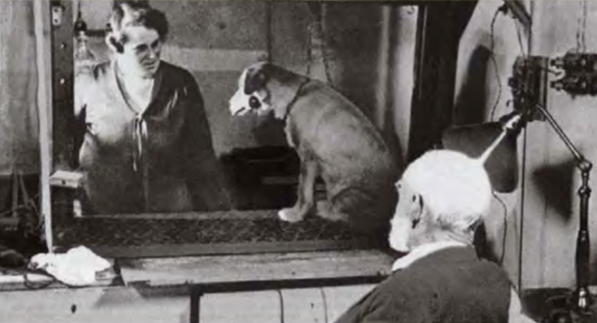
AT FIRST; Russian physiologist Ivan Pavlov (1849-1936) wanted only to know the neural link between dinner and dog drool. To find out, he anesthetized his test subject and detached its salivary duct, lightly stitching this to the dog’s outer cheek. Then, placing food in the dog’s mouth, he could eaSily collect and calculate its salivary response. In this way he hoped to unlock the mysteries of the canine nervous system.

After repeated experiments, Unfortunately the dog seemed to catch on and began to salivate before the food had arrived. Clearly this was a problem. How could Pavlov understand salivary response to food in the mouth if the response occurred in the absence of food? Initially puzzled, Pavlov realized he’d stumbled upon something even more intriguing than his original objective. As environmental factors determine evolutionary adaptations within a species, he concluded, so too must external forces mold the behavior of an individual.

Ivan Pavlov observes one of the dogs he subjected to conditioned behavior experiments.

From a knee-jerk defense mechanism to the performing of Rachmaninoff, acquired reflexes are the building blocks of learning. And if dogs’ brains were sophisticated enough to make such connections, imagine what human brains could do.

Pavlov soon discovered he could condition animals to respond to arbitrary stimuli. If a snack was repeatedly paired with buzzer, whistle, or A-minor triad on the piano-he rarely used that legendary bell-the dog would begin to salivate at sound alone. But a slight variation-B-flat minor, perhaps or A minor in a different octave-triggered no response. The same held for shapes, clocks, shades of gray,melodic patterns, light and rotating objects.

GROWING COMPLEXITY [ EVOLUTION ( BRAIN DEVELOPMENT ) ]

GROWING COMPLEXITY [ EVOLUTION ( BRAIN DEVELOPMENT ) ]

GROWING COMPLEXITY

If 2,000 neurons are sufficient for simple learning, imagine the explosion of complex behavior that accompanied the growth of neural complexity about 530 million years ago. Larger clumps of neurons in the diverse animal population that seemingly emerged overnight encouraged the flourishing of new animal species. The variety of new species could better react to, and survive, changes in their environments. Ocean life diversified into the ancestors of today’s worms, mollusks, and crustaceans.

The forward tip of the neural cords in the first proto-vertebrates began swelling and folding to create primitive brains. Neural networks in those early brains began to diversifY. Some connections began to specialize in vision. Some took on the function of hearing. Among the sharks, neural connections specializing in smell became hypersensitive, empowering them to detect blood in concentrations as small as 1 part per 25 million of water. That allowed them to smell bloody prey a third of a mile away (and, not coincidentally, strengthened their chances for survival in the constant interspecies combat of evolution).

A developing spinal cord is already visible in a three-day-old chicken embryo developing inside its eggshell.

As animals began crawling out of the ocean onto the shore, around 360 million years ago, their brain didn’t begin anew. Instead, new experiences and new evolutionary developments were laid down atop their existing neural networks. Birds and reptiles added new levels of behavior, and new brain matter developed as well. Mammals put their own layers on top of their evolutionary predecessors. And finally, humans with their gigantic brain added the newest and most complex layers in the wrinkly pink walnut of the cerebral cortex.

Darwin explicitly put humans in the crosshairs of his theory with the 1871 publication of The Descent of Man. Human bodies and brains evolved and continue to do so.

The human brain differs physically from those of other mammals in its size, complexity, and dominance of its cerebral cortex. Just like speed and strength, early advantages in the brain such as analytical power (“How can I trap that animal?”) and capacity for speech (“How can I get others to help me trap that animal?”) improved the odds of early humans’ survival. Advantages spread to new generations and became common.

Networks of synapses constantly compete with each other; roughly like animal species fighting for limited food. Networks that get steady stimulation grow stronger; while others atrophy. Nobel laureate Gerald Edelman calls the process neural Darwinism.