Tag Archives: Why Learning English Is Easy When Done the Right Way

Common English Sentence Patterns | english.humanityuapd.com

Common English Sentence Patterns

Common English Sentence Patterns

A sentence pattern is a basic structure that illustrates how words connect to create meaningful sentences. Essentially, these patterns serve as the building blocks of sentences, allowing us to communicate effectively in English. Understanding sentence patterns is crucial for language learners because it helps in organizing thoughts in a clear and coherent manner while speaking or writing.

At its core, a sentence pattern consists of a combination of different elements that generally include a subject and a predicate. The subject tells us who or what the sentence is about, while the predicate reveals what the subject does or is. For instance, in the simple pattern “Subject + Verb”, we see that the sentence conveys a straightforward action, such as “The cat sleeps.” This basic pattern forms the foundation for constructing more complex sentences.

As language learners engage with various sentence patterns, they become adept at expressing their ideas more fluently. Knowing different structures also enhances a learner’s ability to understand others. When speaking, using recognized patterns encourages clarity, helping listeners grasp thoughts without confusion. For example, the pattern “Subject + Verb + Object” allows for rich information delivery, as in “She reads a book.” Here, the sentence clearly indicates who is doing the action and what the action affects.

In summary, sentence patterns not only provide structure to sentences but also facilitate effective communication. They enable learners to express themselves confidently and logically, which is an essential skill in mastering the English language.

Learning sentence patterns is a critical aspect of mastering the English language, particularly for beginners. These patterns serve as foundational structures that help learners create sentences with confidence and ease. By understanding and utilizing common sentence patterns, students can significantly reduce the complexity involved in forming thoughts into coherent expressions.

For instance, consider the simple pattern “Subject + Verb + Object.” A learner familiar with this structure can readily form sentences like “The cat (subject) chases (verb) the mouse (object).” This basic pattern can be expanded through various modifications, such as adding adjectives, adverbs, or prepositional phrases, allowing for the construction of more complex sentences without feeling overwhelmed. In this way, mastering these structures promotes grammatical accuracy and fluency.

Furthermore, when learners encounter new vocabulary or ideas, knowing sentence patterns can expedite the process of integrating these elements into spoken or written exchanges. Rather than facing a blank slate, which can lead to frustration, learners can rely on established frameworks to express themselves. For example, using the pattern “There is + a/an + noun” enables a beginner to introduce new concepts: “There is a book on the table.” This structure not only improves their speaking abilities but also assists in reinforcing their understanding of English syntax.

Additionally, having a repertoire of sentence patterns encourages learners to experiment with language and promotes a more engaging learning experience. Instead of rote memorization of isolated words, a focus on sentence structures allows students to form connections between their thoughts and the English language, making communication feel more intuitive. Such an approach ultimately leads to quicker mastery of conversational skills and increased confidence in speaking.


Speaking Practice Using Grammar | 28-day free course

Speaking Practice Using Grammar

Speaking Practice Using Grammar

Engaging in speaking practice is fundamental for language learners aiming to achieve proficiency and fluency. This aspect of language acquisition allows individuals to develop their communication skills through real-time conversation, which in turn enhances their confidence when engaging in dialogues. The significance of speaking lies not only in the articulation of thoughts and ideas but also in the ability to interact effectively with others. Through regular speaking practice, learners are exposed to various conversational contexts, simulating real-life interactions that prepare them for actual scenarios.

Moreover, speaking practice serves as a platform where learners can test their understanding of grammar in practical applications. When individuals articulate sentences and express emotions verbally, they inherently utilize grammatical structures. This active use of grammar is essential because it aids in solidifying the learner’s knowledge, making them more proficient in employing these rules during spontaneous conversations. Mastery of grammar leads to greater clarity and precision in communication, allowing speakers to convey their messages without ambiguity.

Improving one’s speaking skills is inherently linked to building self-assurance in using the language. As learners practice speaking, they gradually overcome fears related to making mistakes in pronunciation or grammar. This progression fosters a positive environment for communication, where individuals feel encouraged to participate in discussions without hesitation. Ultimately, consistent speaking practice not only refines language skills but also promotes a sense of connection and engagement with others, essential elements in effective communication.

Past Tense for Beginners | english.humanityuapd.com

Past Tense for Beginners

Past Tense for Beginners

The past tense is a fundamental aspect of language that allows speakers and writers to convey actions that have taken place in the past. Understanding how to properly use the past tense is essential for effective communication, as it provides clarity regarding when events occur in relation to the present moment.

In terms of its grammatical structure, the past tense generally modifies verb forms to indicate that an action has occurred. For instance, the verb “to walk” transforms into “walked” to signify that the walking happened at some point in the past. This ability to articulate past actions with clarity aids in storytelling, reporting events, and sharing experiences.

Mastering the past tense is particularly crucial for learners of a language, as it not only enhances their ability to communicate but also enriches their understanding of narrative techniques. For instance, professionals in writing and journalism rely heavily on the past tense to accurately depict events that have transpired. Additionally, everyday conversations benefit from the use of the past tense to recount personal stories or share historical events.

The past tense is also vital in relation to other tenses, as it helps position an action within a timeline, allowing for a more comprehensive grasp of when events happen. By using the past tense effectively, individuals can construct meaningful narratives that resonate with their audience. Therefore, recognizing the importance of the past tense can significantly contribute to one’s linguistic proficiency and overall communication skills.

Talking About Daily Routine in English

Talking About Daily Routine

Talking About Daily Routine

A daily routine refers to the set of activities that individuals regularly engage in throughout their day. These activities are often consistent and form a crucial part of one’s life, enabling a sense of structure and predictability. Most people have a variety of daily routines, which may vary in complexity and length from person to person.

Typically, a daily routine starts with waking up, which serves as the first major activity of the day. Upon waking, individuals often engage in activities such as brushing their teeth, showering, and getting dressed. This initial part of the day sets the tone for how the rest of the day will unfold. Following this, many people proceed to have breakfast, which is considered an important meal, as it provides the necessary energy to kick-start the day.

Additionally, many individuals have work or school obligations that form a significant part of their daily routine. This may involve commuting to a workplace or engaging in academic activities, such as attending classes and participating in discussions. Breaks during the day, such as morning coffee or lunch breaks, also play a pivotal role in maintaining productivity and providing necessary rest.

Furthermore, after work or school, people often unwind through various activities, such as exercising, cooking dinner, or spending time with family and friends. These evening routines can vary widely, encompassing hobbies, relaxation methods, or social engagements, creating a fulfilling end to the day.

Daily routines can differ greatly based on cultural, professional, or personal preferences, yet they share a common theme of regularity and structure. Understanding the components of a daily routine helps in appreciating the rhythm of day-to-day life.

Present Tense | learn English in 28 days | english.humanityuapd.com

Present Tense

Present Tense

In the English language, verb tenses play a crucial role in conveying the timing of actions and events. Tenses essentially serve as grammatical tools that allow speakers and writers to organize thoughts in relation to time. Among the various tenses, the present tense holds a significant position due to its frequent application in daily communication and written expression. It serves not only as a means of stating facts but also as a way to express habits, current situations, and general truths.

Understanding tenses can greatly enhance one’s proficiency in English. Each tense illuminates a different aspect of time, allowing for precise and effective communication. The present tense, for instance, generally indicates actions that are happening now or are habitual in nature. This aspect of the present tense is vital for everyday interactions, such as in conversations where individuals share experiences, express opinions, or describe their routines.

Moreover, the use of the present tense is not limited to spoken language; it is equally applicable in writing. Writers often rely on the present tense to convey immediacy and relevance in their narratives, making the text more engaging for readers. By integrating the present tense into one’s writing, authors can create a direct connection with their audience, drawing them into the unfolding action or argument.

In summary, the present tense, as a pivotal component of English verb tenses, assists in structuring dialogues and narratives. As we delve deeper into the specifics of the present tense, it is essential to appreciate its foundational role in effective communication within the English language.

Prepositions (In-On-At) | Amazing English Free Course

Prepositions In-On-At

Prepositions In-On-At

Prepositions are essential components of English grammar that serve to establish relationships between different elements within a sentence. Specifically, they connect nouns, pronouns, or phrases to other words, clarifying how they interact within the context of a statement. By doing so, prepositions play a crucial role in conveying various types of relationships, primarily concerning time, place, and direction.

In the realm of language, prepositions function as a bridge that links different parts of a sentence. For example, in the phrase “The book is on the table,” the preposition “on” connects the noun “book” to the noun “table,” indicating a spatial relationship. Similarly, prepositions can also indicate time, as illustrated in the sentence “We will meet after lunch,” where “after” denotes a relationship concerning temporal sequencing. Additionally, prepositions can express direction, as shown in the sentence “She walked toward the park,” where “toward” indicates the direction of movement.

Furthermore, prepositions often require the use of objects. In many cases, a preposition is followed by a noun or pronoun to complete its meaning, forming what is known as a prepositional phrase. For instance, in the phrase “at the store,” “at” is the preposition, and “the store” serves as its object. This combination provides listeners and readers with a clearer understanding of the spatial context being described.

In summary, the role of prepositions in English cannot be overstated. They facilitate communication by helping to articulate relationships, whether they pertain to location, timing, or movement. Recognizing the significance of prepositions in constructing meaningful sentences is a foundational aspect of mastering English grammar.

Articles | Easy English Course in 28 days | Absolutely Free

Articles

Articles

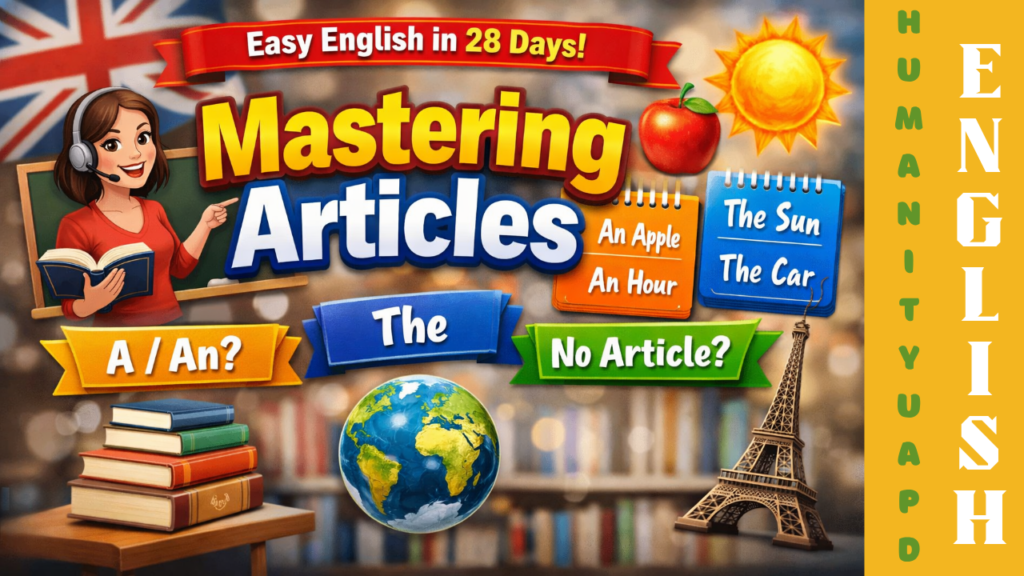
In the English language, articles are essential components that serve to clarify the specificity and definiteness of nouns. They function as determiners, providing crucial information about the nouns they precede. Essentially, there are two types of articles: definite articles and indefinite articles. Understanding how these articles operate within sentences is vital for grasping the nuances of English syntax.

The definite article, “the,” indicates a specific noun that is known to the reader or listener. For example, in the phrase “the book on the table,” the article specifies which book is being referred to, implying that it is a particular book familiar to both the speaker and the audience. This specificity is pivotal in ensuring clear communication.

On the other hand, indefinite articles, which include “a” and “an,” refer to non-specific nouns. They are used when the exact identity of the noun is not crucial or when it is being mentioned for the first time. For instance, saying “a dog barked” introduces the idea of any dog rather than a specific one. Such distinctions play a significant role in conveying meaning accurately.

The use of articles not only aids in avoiding ambiguity but also enriches the English language by allowing greater flexibility in expressing both general and specific ideas. Articles contribute to the syntactic structure of sentences, enabling speakers and writers to convey their thoughts with precision.

Overall, a solid understanding of articles and their proper usage is fundamental for anyone learning English. Mastering this aspect of grammar aids in effective communication, ensuring that messages are delivered clearly and succinctly.

Adverbs | Learn English absolutely free | english.humanityuapd.com

What Are Adverbs

What Are Adverbs?

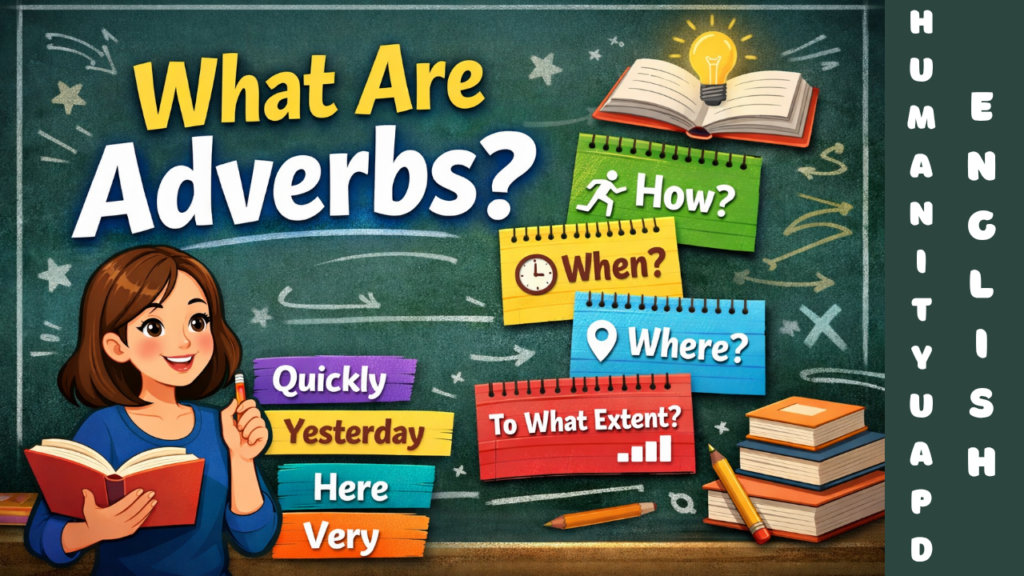
Adverbs are a crucial part of speech in the English language, serving the essential function of modifying verbs, adjectives, and even other adverbs. By definition, adverbs provide additional information about how, when, where, and to what extent an action is performed, adding depth and clarity to sentences. This modification can enhance the reader’s understanding of the action or description being conveyed.

Typically, adverbs can be identified by their ability to answer specific questions such as “how?”, “when?”, “where?”, and “to what extent?” For instance, if one considers the sentence “She ran quickly,” the adverb “quickly” modifies the verb “ran” by specifying the manner in which the running occurred. This enhancement illustrates the importance of adverbs as they significantly influence the meaning of the action being described.

Additionally, adverbs can also modify adjectives, which underscores their versatility. For example, in the phrase “very tall,” the adverb “very” modifies the adjective “tall,” indicating the degree of tallness described. Similarly, adverbs can modify other adverbs, as seen in the phrase “extremely quickly,” where “extremely” augments the meaning of the adverb “quickly.” This ability to modify multiple parts of speech is vital for articulating complex ideas and emotions succinctly.

In summary, adverbs play a significant role in grammar by determining the nuances of meaning in communication. Their capacity to modify various components within a sentence not only enriches the language but also allows for precise and vivid expression. Understanding how adverbs function is fundamental for mastering effective writing and comprehension in the English language.

English Speaking Practice for Beginners – Absolutely Free

Simple Speaking Practice for Beginners

Simple Speaking Practice for Beginners

Speaking practice is a crucial component of language acquisition, particularly for those embarking on their journey to learn English. For complete beginners, engaging in speaking activities from the outset can significantly bolster their confidence and improve their language skills. This initial focus on speaking allows learners to familiarize themselves with the mechanics of pronunciation, intonation, and rhythm that are essential elements of fluent communication.

One common challenge that beginners face is the fear of making mistakes. This fear can inhibit their willingness to participate in conversations, ultimately slowing their progress. By incorporating speaking practice into their routine from the first week, learners can effectively reduce this fear. Experiencing the act of speaking in a supportive environment allows them to understand that making mistakes is a natural part of the learning process. Consequently, learners become more comfortable experimenting with new vocabulary and sentence structures.

Moreover, early exposure to speaking helps to reinforce listening skills, as learners are not only producing language but also receiving immediate feedback. This interaction encourages the development of critical thinking skills, as beginners learn to formulate responses spontaneously. As learners engage in dialogues, they can practice contextualizing their English usage and improve their overall comprehension.

In summary, initiating speaking practice at the very beginning of the learning process fosters a positive language-learning experience. It assists learners in building essential skills while alleviating anxiety associated with speaking. By prioritizing speaking exercises, complete beginners can set a solid foundation for their mastery of English, paving the way for more advanced language proficiency in the future.