Tag Archives: history


Mesopotamia and Persia | A Complete Visual Guide
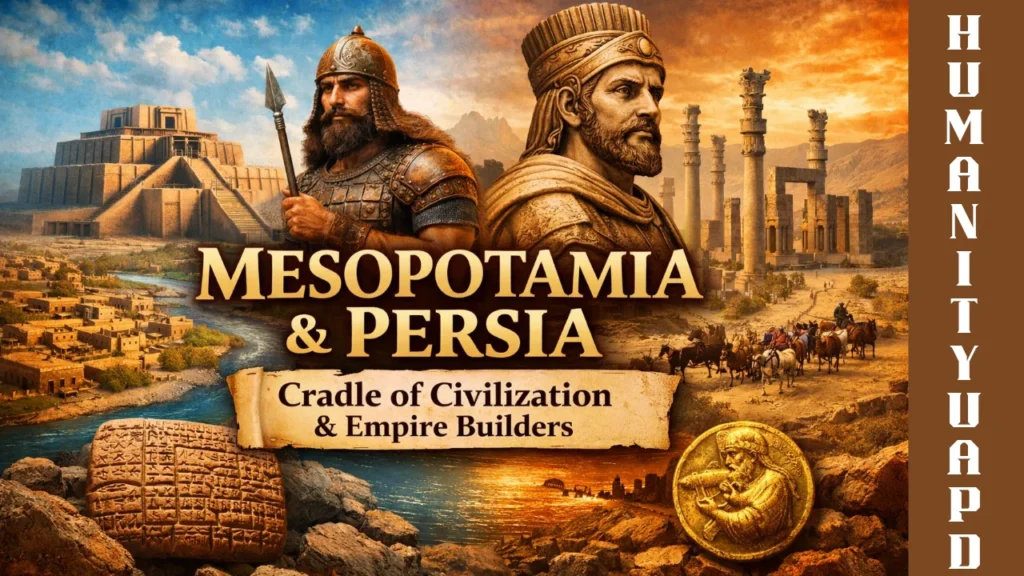
Mesopotamia and Persia
Mesopotamia, often referred to as the “Cradle of Civilization,” is located between the Tigris and Euphrates rivers, primarily in present-day Iraq. This ancient region is notable for being one of the first places where complex urban centers emerged, marking the beginning of significant advancements in human society around 3500 BCE. The key civilizations that thrived in Mesopotamia include the Sumerians, Akkadians, Babylonians, and Assyrians. Each of these societies made substantial contributions to science, mathematics, and writing, with the invention of cuneiform, one of the earliest forms of writing.
Persia, corresponding largely to modern-day Iran, evolved as a significant empire from the 6th century BCE, characterized by its extensive territorial expansion and sophisticated administration under leaders such as Cyrus the Great and Darius I. The Persian Empire became renowned for its innovations in infrastructure, including the construction of roads and the establishment of an efficient postal system. These advancements not only facilitated trade and communication but also enabled a level of administrative organization that influenced subsequent empires.
Both Mesopotamia and Persia played pivotal roles in shaping human history, particularly in scientific domains. They laid the groundwork for mathematics through concepts such as the sexagesimal system, which is still fundamental in measuring time in hours and minutes. Furthermore, the advancements in astronomy and medicine in these regions provided the basis for future studies that would extend throughout the ages.
The enduring legacy of these ancient civilizations continues to resonate today, illuminating the profound impact that Mesopotamia and Persia have had on science, culture, and governance across the globe. Understanding their contributions offers critical insights into the development of human knowledge and society.



Work From Home During War 2026 😱 Iran Israel Conflict & Remote Work Reality

Work from home during the current war (April 2026)
As of April 2026, the geopolitical tensions between Iran and Israel have escalated significantly, impacting various aspects of life, including work environments. The ongoing conflict has resulted in considerable economic and psychological strain on individuals residing in affected regions, creating an urgent need for adaptive strategies in professional settings. The clash between these two nations, marked by military engagements and strategic posturing, has led many to reconsider their work arrangements, prominently ushering in the practice of working from home.
The complexities of the Iran-Israel conflict are multifaceted, involving historical grievances, territorial disputes, and recent incidents that have intensified militaristic rhetoric. Citizens in both countries find themselves navigating a state of uncertainty, grappling with constant developments that might affect their safety and daily operations. As businesses face potential disruptions due to this regional instability, remote work emerges as a viable solution, enabling individuals to maintain productivity while prioritizing their well-being in the face of conflict.
Moreover, the shift towards remote work is not merely a measure of convenience; it reflects a broader societal adaptation to crises. Employees are increasingly recognizing the potential of home offices as safe havens, offering a semblance of normalcy despite the prevailing unrest. In light of this, organizations are investing in technologies and policies that facilitate remote collaboration, creating a virtual workspace that transcends geographic limitations imposed by the ongoing conflict.
In summary, the current geopolitical climate between Iran and Israel necessitates a profound reevaluation of traditional work environments. The transition to working from home during these turbulent times serves as a critical mechanism for resilience, empowering individuals and businesses to continue operating under challenging circumstances while ensuring safety and mental well-being.


Toronto and Vancouver | Canadian Cities | HUMANITYUAPD (2026)

Toronto and Vancouver
Toronto and Vancouver, two of Canada’s most prominent cities, serve as vital cultural and economic hubs within the country. Geographically, Toronto is located in the southeastern part of Ontario, on the northwestern shore of Lake Ontario, while Vancouver lies in the southwestern region of British Columbia, along the Pacific Ocean. Both cities not only represent diverse cultural landscapes but also distinctive geographical characteristics that influence their unique urban identities.
In terms of size, Toronto is Canada’s largest city, boasting a population of over 2.7 million residents. It is characterized by its expansive urban sprawl, which encompasses a variety of neighborhoods that contribute to its rich multicultural tapestry. Vancouver, although smaller, with a population of approximately 631,000, is known for its stunning natural scenery and strategic location as a gateway to the Pacific Rim.
The significance of these cities extends beyond their population numbers. Toronto serves as the financial capital of Canada, housing major banks and corporate headquarters, contributing significantly to the national economy. Vancouver, on the other hand, is recognized for its robust tech industry and thriving trade relations with Asia, further establishing its economic importance.
This blog post aims to provide a comprehensive scientific comparison between Toronto and Vancouver, emphasizing key aspects such as climate, economic factors, demographics, and overall livability. By exploring these elements, we seek to uncover the nuances that define each city, outlining how these variables contribute to their respective desirability as places to live, work, and visit. Understanding these differences not only enhances our appreciation of these cities but also highlights the importance of informed decision-making for potential residents and businesses contemplating their next move in Canada.


You must be logged in to post a comment.